

Introduction to Social Network Analysis (SNA)
Published: 20 April 2026
While network analysis events have typically attracted social science researchers, March 2026 saw one of the first SNA workshops created specifically for arts and humanities PhD researchers based at Scottish universities.
By Dr Cristina Chueca Del Cerro (Durham University) and Katharina Pruente (University of Stirling) — co-organisers of the workshop.
The idea for putting together a CDF application for a workshop on social network analysis in the arts and humanities took shape in June 2025, after the fourth edition of our annual Roundtable for PhD students, which was organised by Dr Cristina Chueca Del Cerro and Katharina Pruente, two committee members of the Social Network Analysis Scotland (SNAS) group. SNAS brings together researchers from all disciplines and backgrounds to promote network analysis in Scotland through seminar series, academic workshops and other drop-in events, and is peer-led by a group of researchers from higher education institutions in Scotland and beyond. Seeing the high engagement from PhD students in the social sciences, who attend our annual roundtable events to come together to discuss social network analysis in their own research, we decided to put together a CDF application to give PGRs in the arts and humanities an opportunity to learn more about social network analysis and how it could be used in their own research.
Network analysis is a popular method for researchers in the social sciences but is not as well-known in the arts and humanities, which is why we wanted to put together a half-day workshop that was directed specifically at postgraduate students in that area.
Our aim was to introduce network theory to a new audience and help doctoral researchers investigate whether network analysis might be a good fit for their studies. We are extremely grateful to the Scottish Graduate School for Arts and Humanities for funding our workshop and for helping us advertise the session to the relevant audiences, and for the University of Stirling Library for hosting us in their beautiful Innovation Suite. Likewise, we thank everyone who assisted with the organisation and advertisement of the workshop, most notably the FAH Faculty Office at Stirling, the Scottish Graduate School of Social Sciences, and the Postgraduate School administration teams at several Scottish universities.
Workshop delivery and discussions
We received over twenty applications from postgraduates in Scotland and England from various disciplines, including history, linguistics, communication, digital humanities, culture and heritage. In the end, we were joined by thirteen participants, who travelled to Stirling from universities in Glasgow, Edinburgh and Aberdeen besides Stirling. We were extremely pleased to receive expressions of interest from a number of very strong applicants, which made for interesting discussions and presentation questions throughout the day. Thank you to everyone who could join us!
We began the workshop with some ice breakers to introduce participants to each other and establish common ground from the beginning, which helped get us off to a solid start and facilitated communication throughout the day before moving on to several short presentations by SNAS committee members. Dr. Gil Viry (University of Edinburgh) introduced the core concepts and theories behind social network analysis followed by a short discussion of ego networks and their application in academic research by Dr. Matjaz Vidmar (University of Edinburgh. We ended the morning session with an introduction to network analysis software, led by Cristina, who showcased several software packages that are available to analyse and visualise social networks and their features.
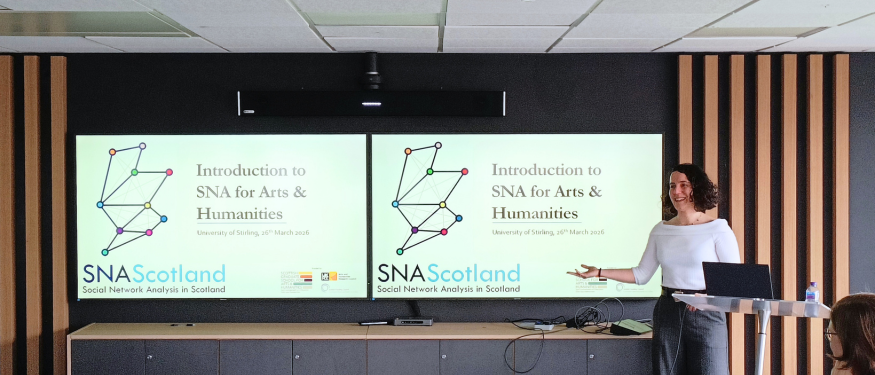
For the applied case studies in the arts and humanities, we presented a combination of case studies from Kat and Chamil Rathnayake (University of Strathclyde), who each highlighted their approach to suing network analysis in humanities research. Kat, a doctoral researcher at Stirling, who is funded through SGSSS, presented her PhD work on Scottish clan communities in the early modern period, in particular Clan Campbell and affiliated kin groups, touching on archival data collection, data processing and how we can visualise historical networks using UCINet. Then, Chamil introduced his ongoing work on social media narratives around renewable energy, which uses network analysis to identify the actors behind promoted content by influencers.
In the afternoon session, Gil did a brief recap of potential applications of network analysis in the arts and humanities before workshop participants split into smaller break-out groups to discuss who they might design their own social network studies under the supervision of members of the SNAS committee, who offered tailored advice on individual projects and answered questions. The discussions were so exciting that we run over time, which is always a good sign for these types of events! Several of the workshop participants expressed that they would be keen to have further workshops and roundtable events for PGRs in the nearer future.
Participant reflections
Following the conclusion of the event, we asked attendees for their thoughts and feedback on the workshop through a short survey. We are happy to report that we received an overwhelmingly positive response from all participants.
Many of them had joined our workshop having little to no knowledge of SNA but now expressed feeling far more confident in their own ability to build and interpret networks as part of their own research.
Student testimonials highlighted a welcoming and encouraging atmosphere throughout the workshop and emphasised their appreciation for having the opportunity to receive specialised training in a research method that is not always available to researchers in the arts and humanities but has the potential to significantly improve our understanding of historical networks, social media exchanges and various other topics. Students also highlighted the collaborative approach and the usefulness of the various presentations and discussions during the event, which helped participants understand what network analysis could do for them. We are so pleased that several workshop participants now consider using network analysis in their own studies.
Once again, we want to thank SGSAH for their support making this workshop possible. It was a real joy meeting everyone at Stirling last month and we hope to run similar events again in the future to introduce network analysis to more researchers across Scotland.
First published: 20 April 2026